Our investigation began with a rumour: Citrix NetScaler might be vulnerable to a new, unpatched, pre-authentication remote code execution (RCE) issue. Although some rumours are best left alone, a possible zero-day on an edge device is not one of them.
So we asked around: had anyone seen any weird logs or behaviours? We sent out a message in a bottle and, soon enough, one came back.
Uncanny user agent
Colleagues from the European Court of Auditors and the European Central Bank swiftly identified some IP addresses in the NetScaler logs (big thanks to them!), hammering requests with base64 bash encoded commands in the User Agent:
.../logon/LogonPoint/tmindex.html" "INDEX:Y2htb2Q...Long story short, once decoded and executed, these bash commands modify /etc/httpd.conf to enable php_engine and then deliver a web shell in a path reachable from the Internet. But that is only post-compromise activity.
Defenders, take note: PHP web shells for persistence seem to be a popular choice on such appliances.
Pulling the thread
Code execution directly from the User Agent? Surely, it cannot be that easy...
Almost. We reviewed more logs and landed on the NS log file, which contained some equally interesting commands:
[..] process_kernel_socket: call to authenticate user :pitboss PPE missed too many heartbeatsNSPPE;grep${IFS}INDEX:${IFS}/var/log/htt*|sed${IFS}'s/.*INDEX://;s/".*//'|b64decode${IFS}-r|sh;, [..]A user name with some very specific strings, followed by some commands: well, well, well...
To break it down, the threat actor:
- does a
grepof the HTTP logs; - does a
sedof theINDEX; - decodes the base64 encoded commands and executes it with Bash.
This is what triggers the payload we had seen earlier in the HTTP logs.
The powerful weapon
Thus, this was most likely a log injection. Yet, the threat actors kept spamming, and nothing seemed to happen.
Is there a race condition? What is triggering it? Or were we hallucinating an RCE and all of it were just random payloads?
We looked further into the NetScaler code for this oddly specific pitboss PPE missed too many heartbeats line.
In this Agentic AI era, we took our most powerful weapon as DFIR analysts... awk. Just kidding. That is far too complicated. So we just did grep -ir.
Among all the matches, one stood out like a sore thumb:
./netscaler/ns_monuploadd_err.pl: my $WR_PPE_COREFILE_NAME = `egrep -i "pitboss.*PPE.*missed too many heartbeats|pitboss.*PPE.*unexpectedly died" @WR_FILES |\``````aa```That brought us to the last piece of the puzzle.
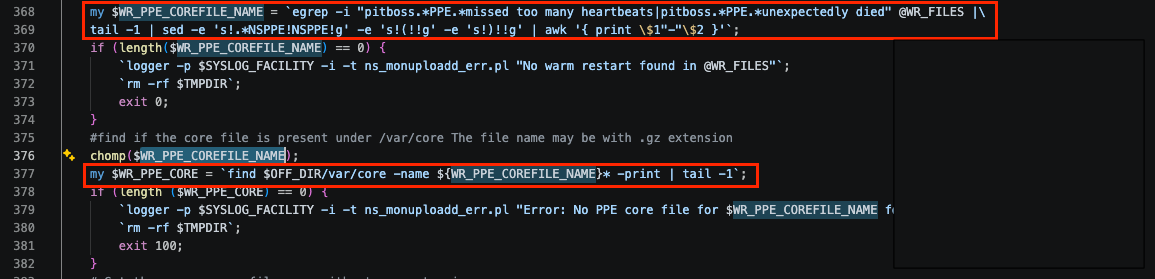
$WR_PPE_COREFILE_NAME is “grepped” from var/log/ns.log.0, /var/log/ns.log and /var/log/messages log files. It is then interpolated and “unquoted” into a shell command. The sed/awk pipeline at lines 368-369 only guarantees the value is two white-space-delimited tokens joined by -.
The | tail -1 explains the hammering: only the last matching line counts, so the attackers needed theirs to be the most recent one when the script ran
Any last log line like this one would therefore be executed pitboss: PPE NSPPE missed too many heartbeats;id>/tmp/not_a_good_sanitation.
Nobody was hallucinating.
Putting it all together
- Attackers fill the HTTP logs with base64 encoded payloads in the User Agent;
- in parallel, they hammer the authentication logs with the exploit, in the hope that their trigger will be the last log line in case
ns_monupload_erris called; - they wait;
- when
ns_monupload_erris called, it greps the logs forPPE NSPPE missed too many heartbeats, and executes the payload trigger.
It turns out we were investigating CVE-2026-88771. Citrix released a patch for it on Sunday 27 September 2026. The patch also addresses other vulnerabilities.
Key takeaways for defenders:
- Hunt in your authentication logs for the error message
PPE missed too many heartbeats. Then correlate theINDEXin the HTTP requests logs to have the bash commands that the threat actor intended to execute. - Hunt directly for base64 in the user agent section of your HTTP logs requests.
- Check the integrity of your
httpd.conf. - Our colleagues at NCSC-NL published useful detections and hunting scripts last year: https://github.com/NCSC-NL/citrix-2025
- After capturing all exploitable forensics evidence, we recommend patching promptly, as malicious actors will not take long to weaponise these vulnerabilities into a working RCE chain. See our security advisory.
Happy hunting and patching!